
[Invited Colloquium] Fine-Scale Climate Projections Reveal Spatial Heterogeneity in Future Aedes Suitability Across Southeast Asia
[Lecture Information]
- Date & Time: October 15, 2026, 4:00–5:00 PM
- Venue: Room 113, Building 82, Graduate School of Environmental Studies, Seoul National University
- Hosted by: City Energy Lab & BK21 Four Program, Graduate School of Environmental Studies, Seoul National University
- Moderator: Prof. Quan Jige (Graduate School of Environmental Studies, Seoul National University)
[Highlight]
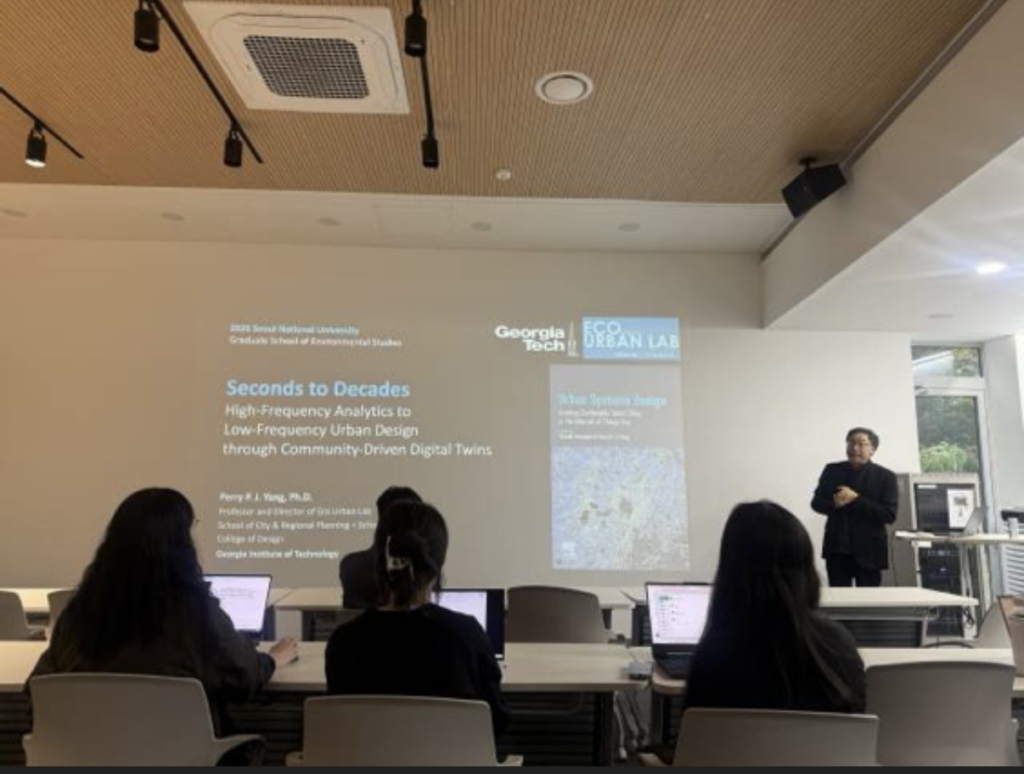
The presentation explored how advances in artificial intelligence (AI), big data analytics, and sensor networks influence human perceptions and experiences of urban spaces, as well as approaches to urban design. Professor Yang highlighted how high-frequency, real-time data analytics at the scale of seconds and minutes can address urban climate risks, such as urban heat islands and flooding, and inform long-term urban design and redevelopment decisions spanning years to decades. The talk emphasized that creating sustainable, resilient, and socially inclusive urban environments requires integrating community-driven urban digital twins with district-scale urban systems design. Drawing on empirical research from the 10-year Tokyo Smart City Studio in Tokyo and the 6-year Urban Systems Design Workshop focused on Atlanta’s airport city in the United States, Professor Yang introduced a multi-stakeholder collaborative framework. He demonstrated how data analytics, ecological design, and spatial modeling can bridge high-frequency urban monitoring with long-term urban planning, enabling decision-makers and urban design practitioners to develop more targeted, context-sensitive climate adaptation strategies across diverse urban scales. Moderated by Prof. Quan Jige, the colloquium provided an invaluable platform for academic exchange, bringing together students, faculty, and researchers in urban planning, spatial analytics, and environmental studies. The session concluded with a vibrant discussion on how spatial data science and interdisciplinary research can better inform sustainable urban planning, climate adaptation strategies, and community-driven digital twin applications.
0 Comments